
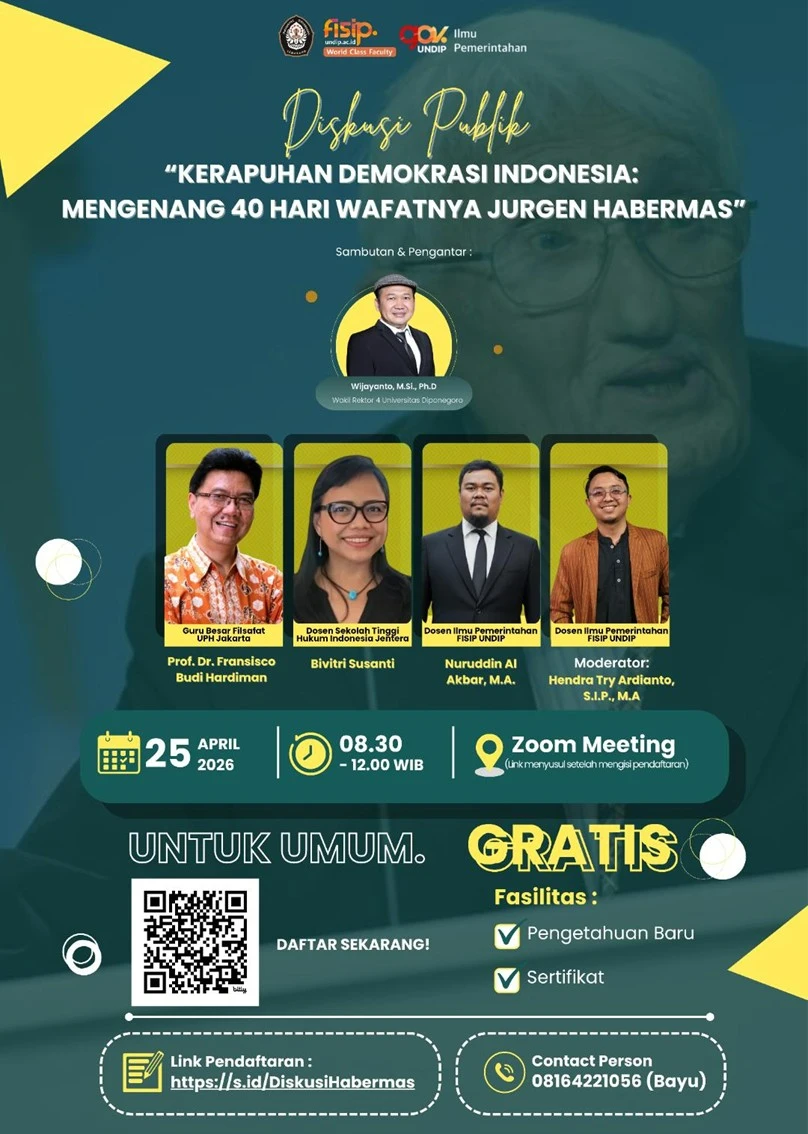

Semarang, April 25, 2026 — The Department of Politics and Government Science, Faculty of Social and Political Sciences, Diponegoro University, held a public discussion titled “The Fragility of Indonesian Democracy: Commemorating the 40th Day of Jürgen Habermas’s Passing,” conducted virtually via Zoom Meeting. This event served as an academic forum for reflection on the state of Indonesian democracy, as well as an intellectual tribute to Habermas’s thought, which emphasizes the importance of a rational, inclusive public sphere free from domination.
The event was opened by the Vice Rector for Research, Innovation, Cooperation, and Public Communication, Wijayanto, M.Si., Ph.D. In his address, he stated that the death of Jürgen Habermas is a great loss for the world of democratic thought on a global scale. He stressed that democracy cannot be understood merely as an electoral procedure, but must be alive in the practice of healthy public communication. Nonetheless, he also highlighted that Indonesian democracy currently faces serious challenges in the form of rising political polarization, pragmatism in power contests, and the weakening of ethics in public communication, all of which collectively threaten the quality of democratic deliberation. In this context, universities especially Diponegoro University hold a strategic responsibility to maintain critical reasoning and serve as spaces for the production of ideas that can strengthen substantive democracy.
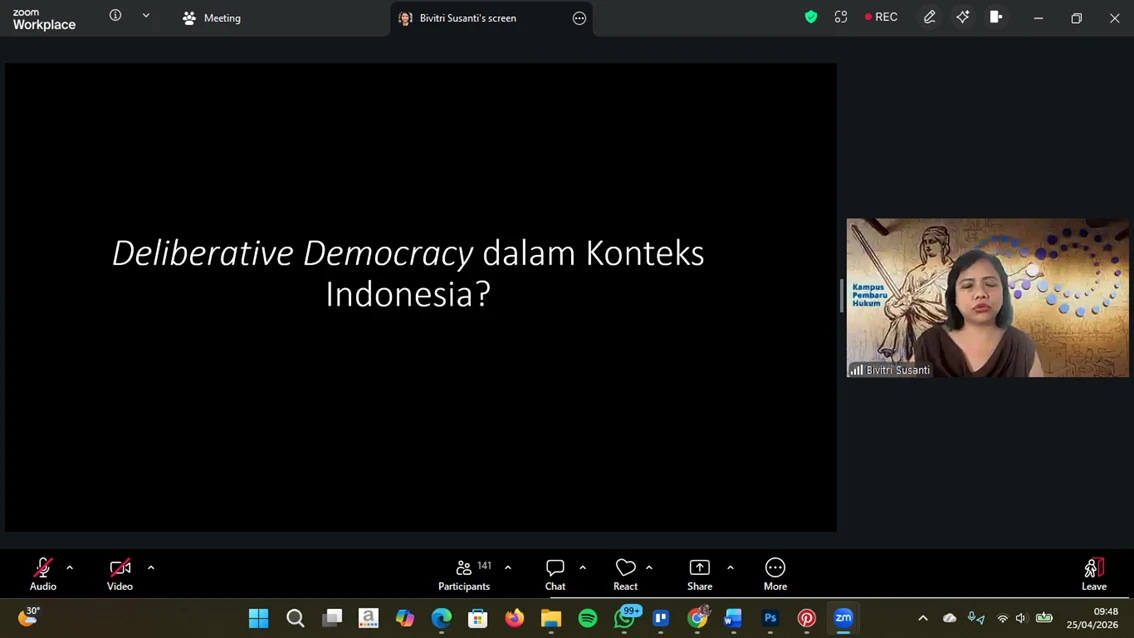
The discussion, moderated by Hendra Try Ardianto, S.I.P., M.A., brought together several academics who analyzed the fragility of democracy from various perspectives. Fransisco Budi Hardiman pointed out that Indonesian democracy is experiencing a crisis of communicative rationality as conceptualized by Habermas: the public sphere no longer serves as an arena for rational dialogue, but is filled with disinformation, propaganda, and identity polarization. He argued that this situation has caused democracy to shift into something merely procedural, lacking deliberative substance. Meanwhile, Bivitri Susanti underscored the phenomenon of democratic backsliding, marked by the weakening of the rule of law, the erosion of checks and balances, and the instrumentalization of law as a tool for legitimizing power. In her view, without a strong rule of law, democracy will lose its normative legitimacy.
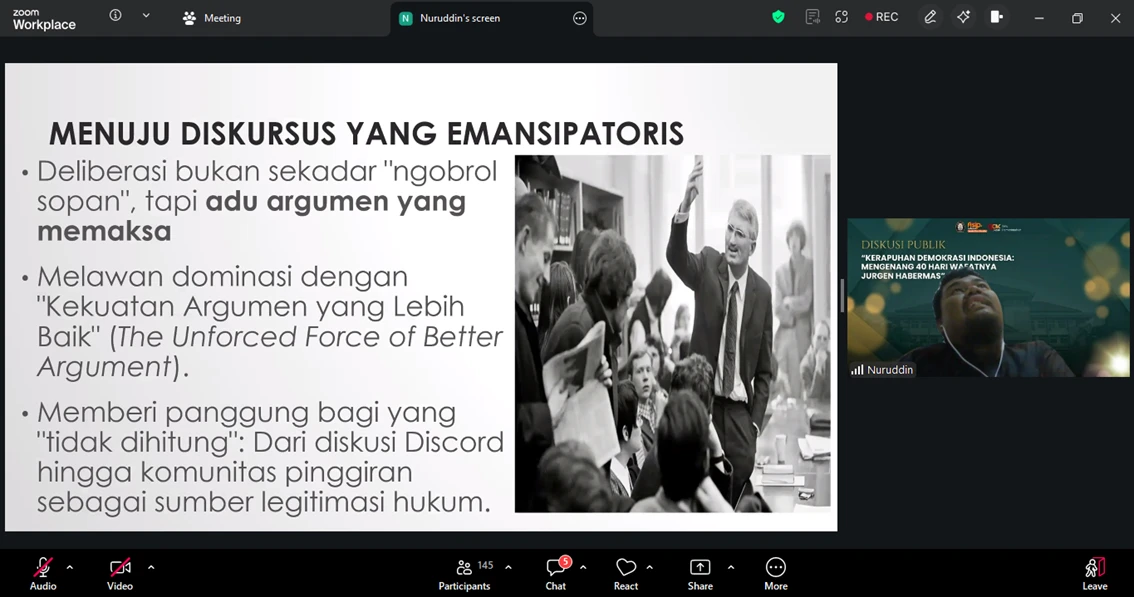
From an academic perspective, Nuruddin Al Akbar highlighted the strengthening of clientelism and transactional politics in Indonesia’s democratic system. He explained that money politics is not only incidental but has developed into a recurring social exchange pattern, forming habitual behavior among both voters and political elites. Under these circumstances, democracy is distorted because political relations are no longer based on rational deliberation but on short-term interest transactions, undermining the quality of political representation.
Overall, the discussion asserted that the fragility of Indonesian democracy is not only institutional but also cultural, characterized by a weakened public sphere, domination of power, and intensifying transactional political practices. Through reflection on the thoughts of Jürgen Habermas, this event is expected to spark ongoing critical discourse and encourage collective efforts to strengthen democracy that is more deliberative, inclusive, and civilized.
0 Comments